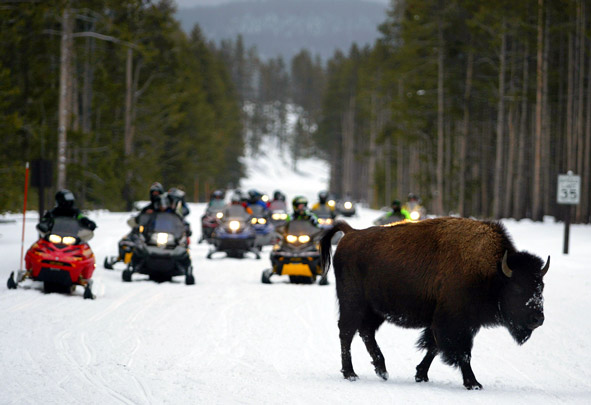
When you think of Yellowstone National Park, you would tend to think of the heart of the National Park Service. You may also think of a pristine, and unique environment offered by no other national park in the United States. You may not, however, think about the snowmobiling and snow coaches that currently trek through the park during the winter season. Currently, Yellowstone has a winter use plan that allows up to 318 snowmobiles and 78 commercially guided snow coaches per day into the park. This plan, however, expires after the 2010-2011 season and the park service is currently working on new policy for future seasons.
So, what is the big deal? Well, the use of snow vehicles in the park raises many concerns. A primary concern is the effect snow vehicle emissions have on air quality. While the current temporary plan requires use of best available technology (BAT), the snow vehicles still emit large amounts of emissions and noise pollution. Although BAT allows for a reduction in emissions, it does not necessarily reduce the concentration of emissions in Yellowstone due to weather effects such as wind, temperature, sunlight, and inversion. Snow vehicles also raise concerns about the effects on wildlife. One study regarding these effects looked into the stress levels of wolves and elks in areas where snow vehicles are active and present, and compared them to areas where there are no snow vehicles. The results consistently showed much higher levels of stress in the wildlife exposed to snow vehicles. Of course, other studies have been done to prove there are no effects, but it is very difficult to tell in the long run. Habituation could occur, causing wildlife to lose instinctive fear of the snow vehicles, which could lead to major problems with predator / prey cycles, direct accidents and many other wildlife problems.
The debate as whether to ban snowmobiles in Yellowstone NP has been occurring for some time. It is argued that a full ban will have devastating economic impacts on local businesses in Wyoming, and that the environmental effects of snow mobiles are minimal. It is in my opinion, however, that because the National Park Service's mission is to preserve the integrity of the parks for present and future generations, that a ban on these vehicles is the most appropriate way of doing so. This is, of course, unless new technology becomes available where environmental hazards could be eliminated. This controversy actually inspired a contest to develop just that. Cleanmobiles, was a contest between engineering students from a dozen universities to compete for building the greenest snowmobile. Currently, there have been no new breakthroughs.
The new Winter Use Plan for Yellowstone National Park is currently open for public comment. If you wish to voice your opinion, visiting their website can help you be heard and receive more information.


I dont think that snowmobiles in Yellowstone are all that bad because of the benefits that they provide. They not only bring in reveneu to the towns surrounding the park but also to the National Park system itself. People pay more money to bring thier sleds to the park to ride them. Also if the park wanted to they could raise the price and im sure people would still pay the price increase for a chance to ride around the park. The snowmobiles allow people with disabilities or the elderly a chance to see more of the park within a limited time than they would ever be able to do without being on a snowmobile. But also They can reach much more remote places then they could have imagined without the use of the sleds. The emissions from just 318 sleds out there at a time cannot have that much of an effect of the atmosphere around the park. Even having a number of groups with a maximum of 318 snowmobiles will not be a big problem with the emissions that they have on them these days. I do believe that we cannot allow the snowmobiles to run absolutly wild throughout the park, but they do have a place for recreation in the park. With many riding areas being taken away all the time we must allow people access to places where they can ride.
ReplyDeleteJust noticed the link for Cleanmobiles was linked to one of the other articles. It should go to the Cleanmobiles article now.
ReplyDeleteThe main concern here is involving one question...when it comes to conservation versus public access, where do you draw the line? Is the park a place to conserve the scenery, natural objects, and wildlife, or a pleasuring ground for the benefit and enjoyment of the people. I believe it should be somewhere in the middle. That is why this is such a controversy. The clean snow mobiles is a great idea, it would be a happy medium!
ReplyDeleteI've been to Yellowstone, and the park is well organized in terms of where tourists are allowed and where they are not. Are you suggesting that the guided snowmobile tours go off of the beaten path into wildlife territory? If this is the case, which I doubt it is, perhaps simply changing the routes of the tours could help? At any rate, Yellowstone is flooded with wildlife, many of which do not fear coming close to cars and other vehicles. When I was there, there were herds of bison walking within an arm's length of my car. I can't imagine that guided tours by park rangers would be any more dangerous for the animals than unguided tours in private vehicles.
ReplyDeleteThe emissions are definitely an issue though, and I do think that efforts should be made at providing tourists with lower emissions, or at least more environmentally safe, tour opportunities.
Well, I think the emissions aspect of the issue is the most problematic. You raise a good point though in that the snowmobile tours are usually guided.It should also be noted that wildlife responses can be diminished by restricting the travel of the snow vehicles to predictable routes and times, reducing the length and number of stops, and reducing activities away from the vehicles during these tours. As long as the ranger is competent and is able to provide interpretation about best management practices, it will greatly help with reducing habituation.
ReplyDeleteGoing on what Katie said there is a main difference between the National Park Service and the US Forest Service. The National Park is for preservation which mean no logging, hunting, and things of that nature. The Forest Service on the other had is more dedicated to Conservation so they allow hunting, fishing, logging. However this is an interesting mix because a great deal of Yellowstone is surrounded by National Forest so I do not see a huge issue to the economies that would be effected. Although going to Yellow stone is much cooler sounding then some National Forest that most people have never heard of. I would like a medium as well because if land is being put aside to preserve something then why not let everyone use it. The only pulling factor in my mind against snow mobiles is the inversion problem. Inversion is when the cool air keeps the emissions at ground level. seeing how it is winter time this is much more likely to happen. However I would like to see a true environmental impact statement done or a comparison to summer months and peak visiting time with how much emissions are going into the air as well as noise pollution. There are many different things to consider but I personally believe the snow mobiles are getting the shaft.
ReplyDelete